
No. 33 Pho Hue Street
Hoan Kiem District, Hanoiinfo@thdv.vn
Office Hour: 09:00am - 4:00pm+84 2439449118
Hotline
English
Tiếng Việt
No. 33 Pho Hue Street
Hoan Kiem District, Hanoiinfo@thdv.vn
Office Hour: 09:00am - 4:00pm+84 2439449118
Hotline
English
Tiếng Việt
30/11/2021 - Hau Giang province is the first place in the Mekong Delta region and Vietnam to facilitate the application of the AGINE and GreenDevi circular economic models, both of which have already borne fruit.
Vietnam has great potential to develop its advanced agricultural production. Among the country’s seven economic regions, the Mekong Delta plays the most important role in agricultural development with an area of 40,428 square kilometres and a population of about 19 million, roughly equivalent to that of the Netherlands.
The AGINE model (Agriculture-Industry-Energy) is the main focus of high-tech organic agriculture in rice cultivation, linking the agricultural processing industry to food products and the production and use of renewable energy. Meanwhile, the GreenDevi model (short for Green Development), which represents green development characteristics in agricultural production, including livestock cultivation, circular production and processing without environmental waste, and maximum use of renewable energy to develop green agriculture and contribute to environmental protection and combat climate change.

In the AGINE block scheme, the black arrows refer to the intermediate product lines or by-products that are circulating internally between farms and factories, while the red arrows are the only final product groups brought to market, including 145,000 tonnes of microbial compost; 2,755 tonnes of processed, frozen, packaged Angus beef; 24,000 tonnes of chicken classified, prepared, packaged, and partly processed into food; 4,000 tonnes of chicken by-products; 10,000 tonnes of packaged precious mushrooms; 42,250 tonnes of high-quality organic rice packaged; 8,750 tonnes of gluten-free rice starch; 2,625 tonnes of ultrafine bran oil and bran powder processed for cosmetic production; Biowish-like preparations, algae; 32,600 tonnes of animal feed; 100 million kWh of green energy a year.
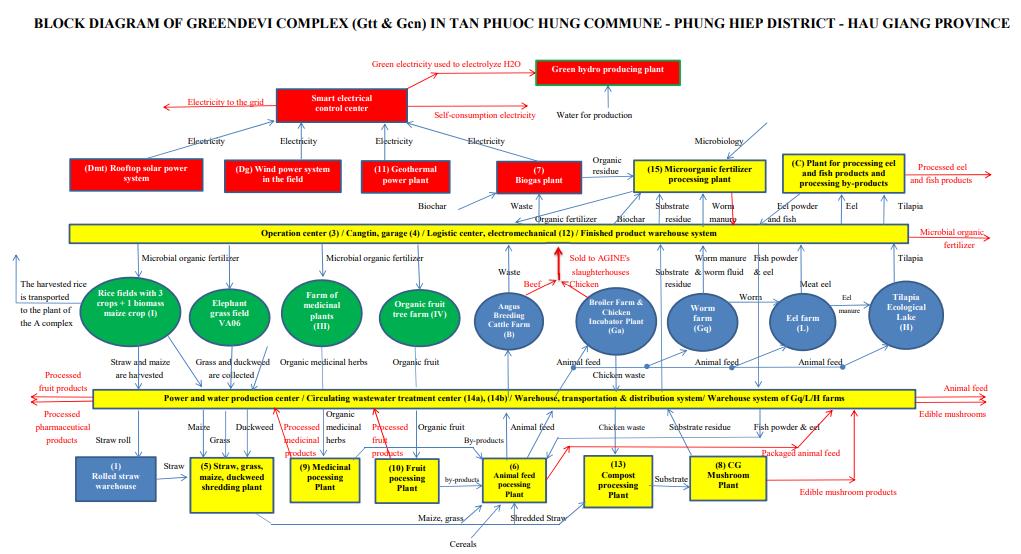
In the GreenDevi block diagram, the black arrows indicate the product lines that mediate internal flow between components; Red arrows refer to the final product lines brought to the market to generate revenue and profit, including18,900 tonnes of chicken maggots; 4,012 6-month-old calves; 2,268 post-breeding heifers (angus breed); 900 cows that no longer reproduce; 210,000 tonnes of farm waste for the production of BioLNG (liquefied natural gas); 4,000 tonnes of cinnamon worm meat; 20,000 tonnes of worm manure and worm fluid for microbial compost; 20,000 tonnes of fresh eel meat; 3,500 tonnes of smoked eel meat; 2,500 tonnes of bacon tilapia fillet; 2,000 tonnes of fishmeal, eel flour as raw materials for animal feed processing; and 240 million kWh of electricity sold to the grid.
The social benefits for farmers working at the circulating economic complexes are also huge. These complexes help to ensure the payment of social insurance and health insurance for farmers, in addition to educational, health, and clean water services for free, among others. The social development targets and investment efficiency are specified as follows:
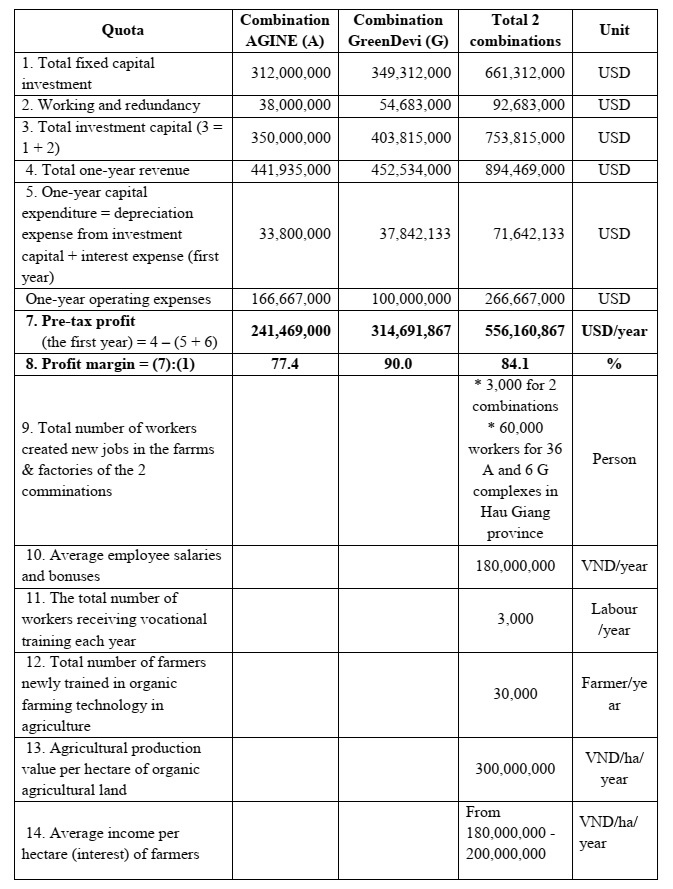
Renewable electricity output (green electricity) and expected scale of reduction in CO2 greenhouse gas emissions are other benefits. With the green development strategy of 36 AGINE complexes and six GreenDevi complexes deployed throughout Hau Giang province by 2030, the total amount of CO2 greenhouse gases can be reduced by 400 million tonnes by 2050, in line with the commitment of the Vietnamese Government at the COP26 Summit.
The Mekong Delta covers an area of 40,428sq.km, equivalent to 4 million hectares, including nearly 3 million ha of agricultural land (more than 2 million ha of rice land). If the government expands the circular economy model to the entire Mekong Delta, the scale of expansion of AGINE and GreenDevi complexes could be 25 times larger than the size of Hau Giang province (the smallest province in the Mekong Delta).
With such assumptions, in 2030-2050, with very high profit margins, the ability to attract domestic and international investment, the whole Mekong Delta can build up to 900 AGINE and 150 GreenDevi complexes. Such agricultural industrial complexes in the Mekong Delta are projected to generate up to $460 billion per year by 2050 with renewable green electricity output of 500 billion KWh per year.
The scale of reduction in CO2 and greenhouse gas emissions thanks to thousands of industrial complexes in organic agriculture in 2024-2050 can be up to 20 billion tonnes of CO2, a significant contribution to reducing greenhouse gas emissions and combating global climate change to fulfill the commitments made by the Vietnamese Government at COP26 in November 2021.
Source: https://vir.com.vn


